South Korea Leads Rare UN Coalition for Global AI Hub Initiative
Interview / Global AI Strategy / South Korea
South Korea’s Global AI Hub Initiative Gains Momentum as UN Coalition Expands
Lawmaker Cha Ji-ho outlines a long-term strategy linking global capital, AI governance, and Korea’s international leadership
Bringing together six United Nations agencies—including the World Health Organization (WHO) and the International Labour Organization (ILO)—under one coordinated framework is so unusual that some observers reportedly described it as something they had “never seen in their entire careers.”
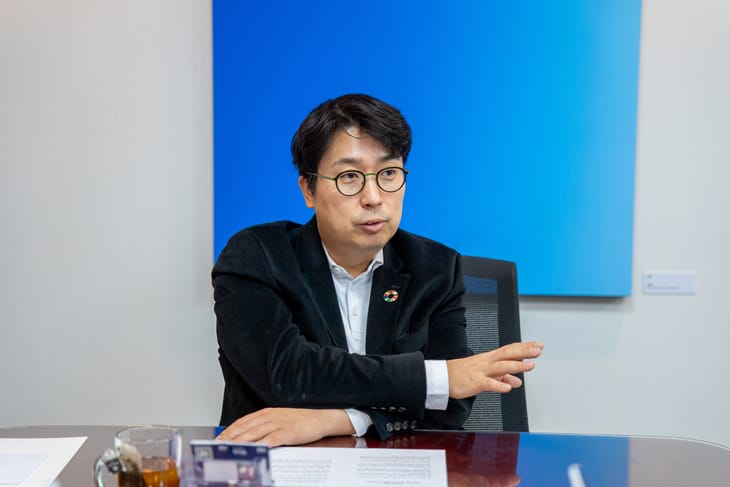
What made the development even more remarkable was that the effort was led not by Europe or the United States, but by South Korea. At the center of that push is Democratic Party lawmaker Cha Ji-ho, whose “Global AI Hub” initiative achieved its first major milestone last month with the signing of memoranda of understanding with six UN-affiliated organizations.
The agreement marks an important step in a broader strategic sequence that has included the attraction of capital from global asset manager BlackRock, the articulation of a national AI vision, and now the initial establishment of a UN-linked cooperation platform in Korea.
Built in Just Over Half a Year
The groundwork for the initiative was laid in the second half of last year, when Kim Woo-chang, National AI Strategy Secretary at the Presidential Office, and Rep. Cha began preliminary negotiations with UN bodies. By December, high-level meetings with UN officials had taken place, and an internal party task force on global AI strategy had been formed.
Significant progress was made along the way. In September of last year, President Lee Jae-myung met in New York with Larry Fink, Chairman and CEO of BlackRock, the world’s largest asset manager, and signed an MOU related to AI and renewable energy. According to the interview, the idea originated with Rep. Cha, who developed the concept and worked closely with Kim Woo-chang—his former KAIST colleague—to move it toward implementation.
Coalition Expected to Expand Beyond Six Agencies
The initiative has accelerated further this year. UNICEF and the United Nations Environment Programme (UNEP) are said to be waiting in line to join, while one additional agency has also shown interest but has not yet been publicly disclosed. If realized, the coalition would expand from six agencies to as many as nine.
Cha believes the economic impact could be substantial. If WHO were to host an AI healthcare conference and ILO were to organize an AI labor-market forum, and each participating organization held events every two months, Korea could effectively become a year-round venue for major international AI gatherings. He described the concept as “bigger than an expo,” comparing it to “hosting an expo all year long.”
A Larger Ecosystem Beyond the UN
For Cha, however, the larger vision goes far beyond conferences. Once UN institutions become established, he expects private companies, academic institutions, and think tanks to follow naturally, creating a broader AI ecosystem around the hub.
He argued that if UN agencies are willing to bring core functions to Korea, there is no reason major technology firms could not do the same. Rather than simply expanding regional branch offices, Korea could potentially attract some of the central functions of global headquarters.
“If the UN is coming, there is no reason why parts of global headquarters functions could not come to Korea as well,” Cha said, emphasizing the long-term potential for strategic relocation and ecosystem formation.
An Interview on Vision, Scale, and Strategy
In an interview at his office in Yeouido, Seoul, on April 1, Rep. Cha said he was more surprised by the muted domestic reaction than by the international response.
“The domestic response has actually been more unfamiliar to me. I did not expect it to be this quiet in Korea,” he said. “Overseas, it has been received as a very significant development.”
Why the Global AI Hub Was Conceived
Cha said the basic idea had been developing for a long time, but the decisive turning point came when President Lee Jae-myung recruited him into politics and tasked him with addressing two major questions: AI and Korean diplomacy.
In his view, the two issues were never separate. AI strategy is not only an industrial strategy and a social strategy; it must also be a global strategy. Because AI is transforming the world simultaneously, he argued, a domestic-only strategy for Korea would always remain incomplete.
He compared a purely domestic AI strategy to Samsung selling televisions only within Korea—possible in theory, but limited in industrial scale and global competitiveness. For that reason, he said, a truly global strategy was essential from the start.
Where the Next AI Opportunity Lies
While many people focus first on manufacturing AI or physical AI, Cha believes the much larger opportunity lies in the knowledge services sector. Manufacturing accounts for a little over 20 percent of Korea’s GDP, but services make up a much larger share and may be able to transition even faster through AI.
He pointed in particular to healthcare. The unmet medical-services market in developing countries is projected, in his assessment, to reach an enormous scale by 2032. If medical AI expands in earnest, Korea could export healthcare services without requiring doctors themselves to relocate abroad.
Because Korea combines strong biomedical infrastructure with advanced AI capability, he believes the government can play a key role by connecting markets through international frameworks and partnerships. Education, too, was highlighted as a field of strong promise, supported by Korea’s powerful public educational data assets such as EBS.
Why the UN Coalition Is So Unusual
Cha described the six-agency coalition as highly exceptional for three reasons. First, it is rare for six major UN agencies to form a coordinated alliance. Second, the fact that the effort was led by Korea, rather than by Europe or the United States, made it all the more striking. And third, the subject itself is AI—currently one of the most fiercely contested fields in the world.
In his view, Korea’s attempt to frame AI not only as an arena of technological competition but also as a matter of public value and global governance gives the initiative unusual strategic importance.
Economic Impact and the MICE Effect
Detailed projections are expected around April, but Cha said the broad direction is already clear. Even from the perspective of exhibitions and conventions—the broader MICE industry—the hub could function as a permanent international event platform.
Global AI-related conferences could be hosted continuously in Korea: WHO on AI healthcare, ILO on AI, labor, and unemployment, and other agencies on their own specialized agendas. If multiple organizations remain active throughout the year, Korea would become a standing venue for international AI dialogue rather than a one-time event host.
A Four-Stage Project
Cha explained that the broader project is unfolding in stages. The first phase was to establish the framework of a global AI basic society as a national policy agenda across ministries. The second phase was to connect Korea to a platform of global capital, since domestic public capital alone would not be sufficient to finance the full scale of AI transition.
That need led to engagement with BlackRock and conversations with Larry Fink around the idea of creating an “AI Asia era.” The third phase is the current AI governance platform centered on the UN-linked Global AI Hub. A fourth phase, he said, is already in preparation, though it has not yet been disclosed publicly.
Political Coordination Behind the Project
Asked about coordination with Prime Minister Kim Min-seok, Cha said the project benefited from leadership that understood both global trends and long-term strategy. He also noted support from the ruling party leadership, which created a new internal position focused specifically on future strategy and allowed him to devote his efforts to projects such as BlackRock outreach, AI governance, and other long-term national initiatives.
He emphasized that the project was not the work of one person alone. President Lee provided the strategic direction, Kim Woo-chang of the Presidential Office worked closely with him throughout, and former aide Choi Byung-min played an important role in refining ideas related to AI and democracy.
Looking Ahead
According to Cha, the current planning cycle begins in 2027 and is designed to continue through the fourth and fifth years of the Lee Jae-myung administration. With six agencies already participating and several more showing interest, the initiative is now entering a critical expansion phase.
As a first-term lawmaker, Cha said he wants to focus on issues that are often under-addressed in politics: the future, and more specifically, the intertwined challenges of AI and climate. In the past, he said, these might have been described as concerns for 20 or 30 years from now. Today, they are challenges expected within the next 5 to 15 years—and therefore demands of the present.