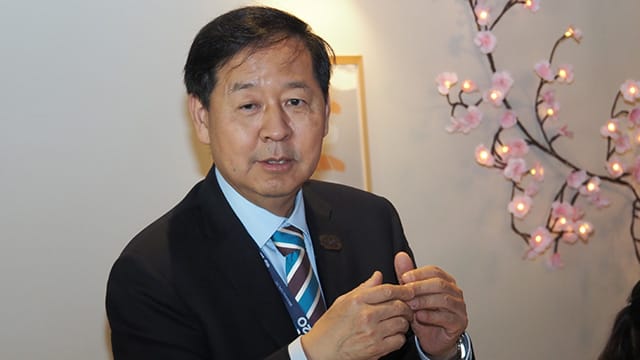
Deputy Prime Minister Koo Yoon-cheol: Korea Could Become a Global AI Hub and Future ‘UN AI Headquarters’
Economy / AI Strategy
Deputy Prime Minister Koo Yoon-cheol: Korea Could Become a Global AI Hub and Future “UN AI Headquarters”
April 17, 2026 | Washington, D.C.
South Korea’s Deputy Prime Minister and Minister of Economy and Finance, Koo Yoon-cheol, has emphasized the need to position Korea as a global hub for artificial intelligence (AI), suggesting that the country could eventually host a “UN AI headquarters.”
Speaking at a press briefing with Korean correspondents in Washington, D.C. on April 16 (local time), Koo outlined the government’s long-term vision for strengthening Korea’s role in global AI governance and infrastructure.
Expanding Korea’s Role as an AI Hub
Koo noted that major international institutions are already moving toward establishing AI-related functions in Korea. The World Bank (WB) has created an AI hub in the country, while six UN-affiliated agencies—as well as the Asian Development Bank (ADB) and the Inter-American Development Bank (IDB)—have also agreed to locate AI hubs in Korea.
He added that the government plans to extend this initiative by requesting participation from the International Monetary Fund (IMF) and the European Bank for Reconstruction and Development (EBRD).
Strategic Focus for Korea’s AI Industry
Regarding Korea’s AI industry, Koo stressed the importance of focusing on key semiconductor technologies essential for AI development, including:
- Memory semiconductors
- High Bandwidth Memory (HBM) for computation and inference
- Power semiconductors
- Sensor semiconductors
He predicted that once geopolitical uncertainties, such as conflicts in the Middle East, subside, Korea could experience a rapid transformation driven by AI and energy innovation.
SLMs Over Large-Scale AI Models
Koo also offered a strategic assessment of AI model development. He pointed out that large language models (LLMs), currently dominated by the United States, require massive land, energy, and infrastructure—areas where Korea may face limitations.
Instead, he suggested that Korea should focus on developing small language models (SLMs) tailored to proprietary data and integrating them into industries where Korea holds competitive advantages, such as:
- Shipbuilding
- Automotive manufacturing
- Consumer electronics
AI as a Solution for Global Economic Challenges
Addressing the upcoming G20 Finance Ministers and Central Bank Governors Meeting, Koo emphasized that AI could play a central role in tackling two key global issues: economic growth and imbalances.
“AI can help improve the efficiency of economic activities and contribute to resolving current account imbalances,” he said.
He noted that widespread adoption of AI could enhance productivity while addressing structural imbalances in the global economy.
Investment and Trade Issues
On the status of a proposed $350 billion investment plan between Korea and the United States, Koo stated that discussions are ongoing to clarify investment targets based on a fact sheet, adding that there are no major disagreements between the two countries.
Regarding a U.S. trade investigation under Section 301 related to allegations of forced labor in Korean salt farms, Koo said that the relevant ministries have already provided explanations and documentation, expressing confidence in Korea’s response.
Koo’s remarks highlight South Korea’s broader ambition to move beyond industrial competitiveness and position itself as a central player in global AI governance and international cooperation.